Brotli vs. Gzip Compression: Which is Better for Website Speed in 2025?
Created on 2 October, 2025 • Checker Tools • 320 views • 3 minutes read
An in-depth comparison of Brotli vs. Gzip compression. Learn how these algorithms work, which one creates smaller files, and which is better for improving your website's loading speed.
When it comes to making a website load faster, every millisecond counts. We optimize images, minify code, and use powerful servers. But one of the most effective speed boosts happens invisibly, in the conversation between your web server and your visitor's browser: compression.
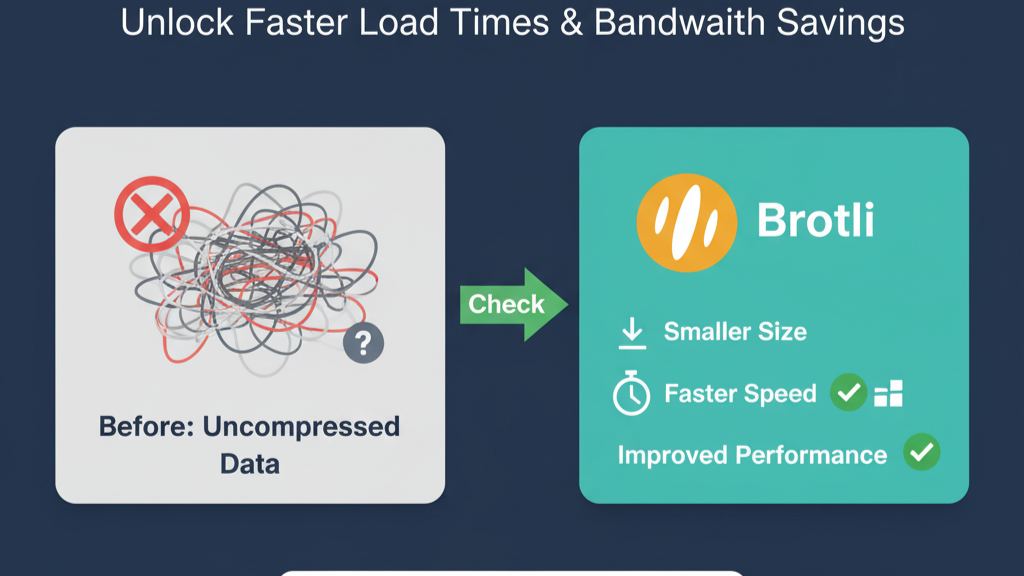
Before sending text-based files like HTML, CSS, and JavaScript, a server can compress them into a much smaller package. The browser then quickly decompresses them upon arrival. For years, the undisputed champion of web compression was Gzip. But a more modern and powerful challenger has emerged: Brotli.
So, in the head-to-head battle of Brotli vs. Gzip, which is truly better for your website's speed in 2025?
The Incumbent: Gzip
Gzip has been the standard for web compression for over two decades. It's based on the DEFLATE algorithm, which works by finding duplicate strings within a file and replacing them with shorter references. It's a reliable workhorse, universally supported by every browser and server, and it does a great job of reducing file sizes.
The Challenger: Brotli
Brotli is a newer, open-source compression algorithm developed by Google. It was designed specifically to be even more efficient for the web. While it also uses a variation of the DEFLATE algorithm, it has a significant advantage: a massive, pre-defined dictionary.
Brotli's 120-kilobyte dictionary is built from a huge corpus of common words, phrases, and code snippets found across the web. This means that instead of only finding duplicate strings within a single file, Brotli can match strings to this vast library of common code, resulting in a much higher compression ratio.
Brotli vs. Gzip: The Head-to-Head Comparison
Let's break down the key differences that impact performance.
Compression Ratio (File Size)
Winner: Brotli
This is the most important factor for front-end speed. Brotli consistently creates smaller files than Gzip. On average, Brotli files are:
- ~20-25% smaller for HTML
- ~15-20% smaller for CSS
- ~10-15% smaller for JavaScript
Smaller files mean faster download times for your visitors, especially on slower mobile connections.
Compression Speed (On the Server)
Winner: Gzip (mostly)
Gzip is generally faster at compressing files "on the fly." Brotli can take longer to compress, especially at its higher quality settings. However, this is largely irrelevant for static assets (your CSS, JS files that don't change). A server can compress these files once at a high level and then serve that highly optimized, pre-compressed version to all visitors. The one-time compression cost is easily worth the savings for every user.
Decompression Speed (In the Browser)
Winner: A Tie
This is crucial. Even though Brotli's compression is more complex, it is designed to decompress extremely quickly. The speed of decompression in the user's browser is comparable to Gzip, meaning there is no performance penalty for the visitor.
The Verdict: Which is Better for Speed?
For improving your website's loading speed, Brotli is the clear winner.
The significantly smaller file sizes it produces lead directly to faster download and page rendering times for your users. While Gzip is still an excellent fallback, the ideal server configuration in 2025 uses Brotli for all static assets.
How to Check if Your Site Uses Brotli
You can't tell just by looking at a website whether it's using Brotli, as the compression is handled invisibly. The most reliable way to know for sure is to use an online checker. These tools inspect the HTTP response headers from your server to see which compression algorithm it used.
For a quick check, the Brotli Checker from Shortus.xyz can instantly tell you if your server is leveraging this modern compression.
If you find your site, whether hosted here in Bangkok or with a global provider, is not yet using Brotli, it’s worth contacting your hosting provider to see if it can be enabled. It’s one of the most effective "free" speed boosts you can get.