What is a URL Redirect Checker? A Guide to 301 vs. 302 for SEO in 2025
Created on 4 October, 2025 • Checker Tools • 361 views • 3 minutes read
Learn the crucial difference between 301 and 302 redirects for SEO. Discover how to use a URL redirect checker to trace the full path and ensure your site migrations are safe.
You've just launched a beautiful new version of your website here in Bangkok, or maybe you've simply updated a page's URL to be more SEO-friendly. You set up a redirect to send visitors from the old link to the new one. All done, right?
Not so fast. Is it the right kind of redirect? Is it pointing directly to the final page, or is it going through a series of unnecessary hops? Getting redirects wrong is one of the most common and damaging technical SEO mistakes a website owner can make.
This is where a URL Redirect Checker becomes an essential tool in your arsenal. This guide will explain the different types of redirects and how to check them properly.
What is a URL Redirect?
A URL redirect is a technique that automatically forwards a user and search engines from one URL to another. They are a necessary part of website maintenance and are used when:
- A page has permanently moved to a new address.
- You are migrating your entire website to a new domain.
- You want to consolidate several pages into one.
- You need to fix a broken link.
The Critical Difference for SEO: 301 vs. 302
While there are several types of redirects, two are critically important for SEO.
301 Redirect: "Moved Permanently"
A 301 redirect is a permanent change of address. It tells search engines like Google that the original page is gone forever and that its authority, relevance, and "link equity" (SEO value) should be passed on to the new URL.
When to use it: Use a 301 for almost every situation—when you change a page's URL, migrate your site, or switch from HTTP to HTTPS. This is the redirect you will use 99% of the time.
302 Redirect: "Found" / "Moved Temporarily"
A 302 redirect signals that the move is only temporary. It tells search engines to keep the original URL in their index and not to pass on the link equity, with the expectation that the original URL will be back soon.
When to use it: Use a 302 only for truly temporary moves, such as A/B testing a new page design or redirecting users to a different page during a short-term promotion. Using a 302 for a permanent move is a major SEO error.
The Danger of "Redirect Chains"
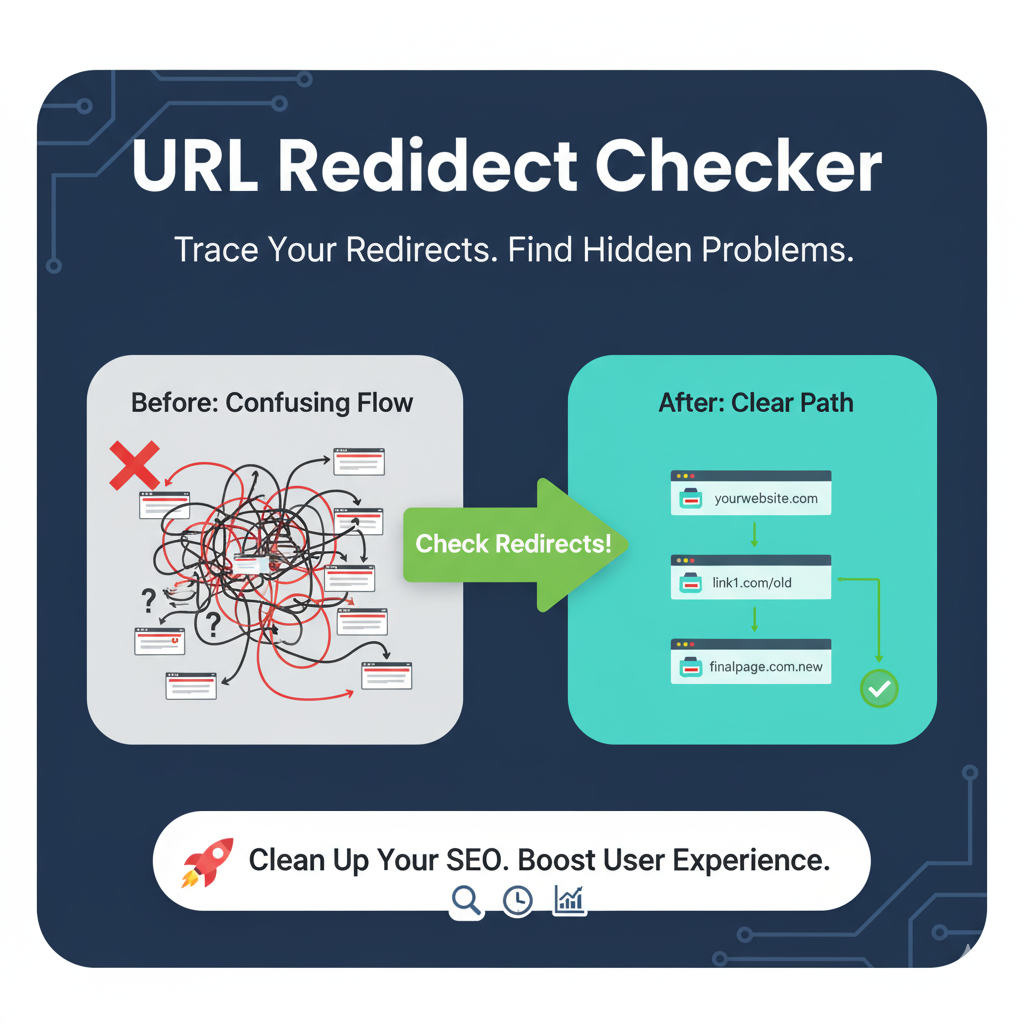
A redirect chain occurs when one URL redirects to another, which then redirects to a third, and so on (Page A -> Page B -> Page C). These chains are bad for two main reasons:
- They slow down your website. Each redirect (or "hop") requires an extra round-trip request between the browser and the server, adding noticeable loading time for your visitors.
- They can dilute SEO value. While Google is good at following chains, it's a best practice to avoid them. Each hop can potentially lose a small amount of link equity and wastes your site's "crawl budget."
Most browsers and search engine bots will give up after a certain number of hops (often around 10), resulting in an error and a failed page load.
The Essential Tool: A URL Redirect Checker
You can't see redirects just by visiting a page; your browser follows them instantly and invisibly. To diagnose these issues, you need a tool that can trace the entire path.
An online URL Redirect Checker is the perfect utility for this. It follows a URL from its starting point to its final destination, showing you every hop along the way. It will reveal:
- The HTTP Status Code for each step (e.g., 301 or 302).
- The full URL of each hop in the chain.
- The final destination URL.
For a clear and detailed trace of up to 10 redirects, the URL Redirect Checker from Shortus.xyz is a great, easy-to-use option for any SEO or webmaster.
Simply paste the URL you want to test into the tool, and it will give you a complete, step-by-step report of the entire redirect path. This allows you to quickly spot incorrect redirect types, find unnecessary hops, and ensure your website's technical SEO is in perfect health.