What is a UUID v4 Generator and Why Do Developers Use It?
Created on 1 October, 2025 • Generator Tools • 278 views • 3 minutes read
Learn what a UUID v4 is, how it's generated, and why its randomness makes it essential for creating unique identifiers in databases and distributed systems.
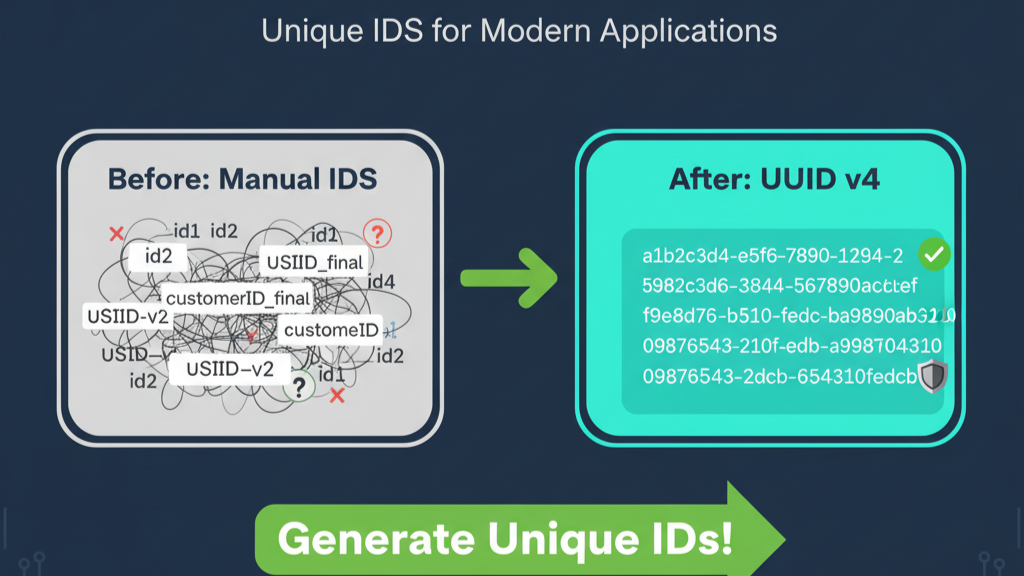
When building any kind of software, from a simple mobile app to a large-scale enterprise system, developers face a fundamental challenge: how to give everything a unique ID. Every user, every product, every transaction needs a distinct identifier so it can be reliably stored and retrieved.
For decades, the standard solution was a simple sequential number—1, 2, 3, and so on. But in the complex, interconnected world of modern software development in 2025, this simple approach has serious limitations. This is where the UUID comes in.
What is a UUID?
UUID stands for Universally Unique Identifier. It is a 128-bit number, typically displayed as a 32-character hexadecimal string separated by hyphens, that looks like this:
123e4567-e89b-12d3-a456-426614174000
Its purpose is right in the name: to be a unique identifier that is, for all practical purposes, guaranteed to be unique in the entire world, without needing a central authority to manage it. The total number of possible UUIDs is so vast (2¹²²) that the probability of two independently generated UUIDs ever colliding is infinitesimally small.
What Makes UUID Version 4 (v4) Special?
There are several different versions of UUIDs, each generated using a different method. While early versions like v1 were based on the computer's network card (MAC address) and the exact time of creation, this had a drawback: it could reveal information about the machine that created it.
The most widely used version today is UUID version 4.
A UUID v4 is generated from random numbers. Of its 128 bits, 122 are dedicated to randomness, while the other 6 are used to signify that it is indeed a "version 4" UUID.
The key advantage of this approach is that a UUID v4 is completely unpredictable. It contains no information about the computer that created it or the time it was generated. This anonymity and randomness make it the perfect choice for a huge range of modern applications.
Where and Why Do Developers Use UUID v4?
Developers here in Bangkok and around the world rely on UUID v4s for several critical reasons:
- Database Primary Keys: In distributed databases or systems with multiple servers, using a sequential number for a user ID can cause collisions if two servers try to create a new user at the same time. Since UUIDs are globally unique, any server can generate a new ID without having to coordinate with others.
- Security: If your user URLs are example.com/user/1, example.com/user/2, etc., it's very easy for an attacker to guess other user IDs. With UUIDs, a user URL might look like example.com/user/123e4567-.... It is impossible to guess the next one, which adds a layer of security.
- Transaction and Request IDs: In complex systems where a single user action might trigger processes across multiple microservices, a unique UUID can be attached to the initial request. This allows developers to trace the entire journey of that request through logs from different systems.
- Preventing Data Leaks: A sequential ID can inadvertently leak business intelligence. If a competitor signs up and gets user ID #1,000,000, they know you have a million users. A UUID reveals nothing.
How to Generate a UUID v4
Most programming languages have built-in libraries that can generate a UUID v4 with a single line of code.
But for those times when you need a quick UUID without firing up a code editor—perhaps for a test database entry or a configuration file—an online UUID v4 generator is the most convenient option. A simple, no-frills tool like the UUID v4 Generator at Shortus.xyz can provide a valid, random identifier with a single click.
In conclusion, the humble UUID v4 is a cornerstone of modern, scalable, and secure application development. It’s a simple solution to the complex problem of creating unique identifiers in a globally distributed world.