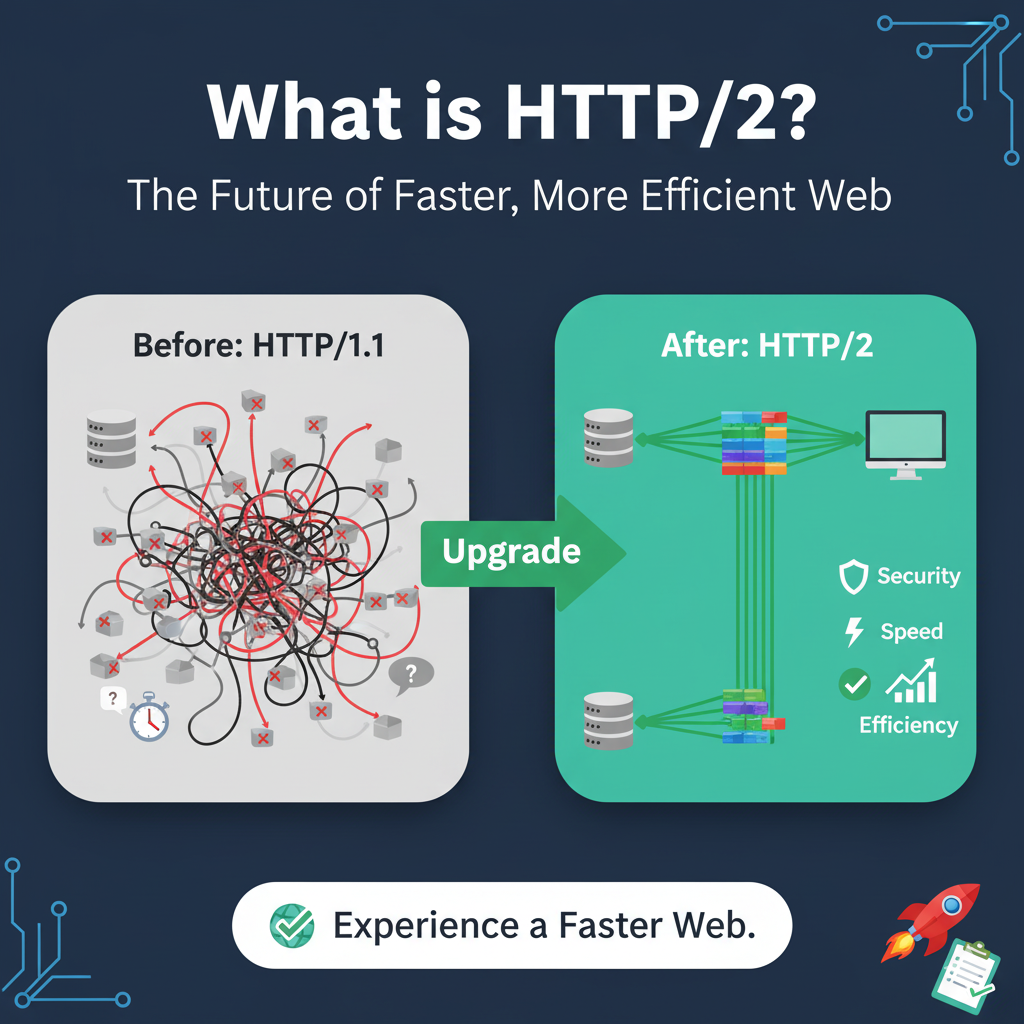
What is HTTP/2? The Benefits for Your Website's Loading Speed in 2025
Created on 2 October, 2025 • Checker Tools • 337 views • 3 minutes read
Learn how the HTTP/2 protocol makes websites faster than HTTP/1.1. Discover key features like multiplexing and header compression and check if your site supports HTTP/2.
In the never-ending quest for a faster website in 2025, we spend countless hours optimizing images, minifying code, and leveraging caching. But one of the most significant performance boosts comes not from what's on your site, but from how it's delivered. This is where the underlying protocol that powers the web, HTTP/2, comes into play.
While it's now the standard for modern web hosting, many older websites or misconfigured servers might still be using the outdated and slower HTTP/1.1 protocol. Understanding the difference is key to unlocking a faster experience for your users, whether they're in a high-speed market like Bangkok or on a slower connection elsewhere.
A Quick Look Back: The Problem with HTTP/1.1
To appreciate the genius of HTTP/2, we first need to understand the limitations of its predecessor, HTTP/1.1.
The biggest issue was a problem called "head-of-line blocking." In simple terms, under HTTP/1.1, your browser could only request one file at a time over a single connection. It would ask for the HTML file, wait, get it, then ask for the CSS file, wait, get it, then ask for the first image, and so on. If any single file was slow to download, it held up the entire queue behind it.
Think of it as a single-lane road. One slow car in front can cause a massive traffic jam for everyone else. Developers had to invent complex workarounds like combining all CSS into one file and all JavaScript into another, just to minimize the number of requests.
The Revolution of HTTP/2: Key Features and Benefits
HTTP/2 was designed specifically to solve these problems and make the web inherently faster. It introduced several game-changing features.
1. Multiplexing (The Game Changer)
This is the single most important benefit. With HTTP/2, a browser can send multiple requests for files at the same time over a single connection. The server can then send the files back in parallel, as they become available.
The head-of-line blocking problem is completely eliminated. To use our road analogy, HTTP/2 is like upgrading from a single-lane road to a multi-lane superhighway. A slow-loading file no longer holds up the entire process. This one feature dramatically reduces page load times, especially for websites with many small assets like images and scripts.
2. Header Compression (HPACK)
Every request and response on the web comes with a set of HTTP headers. With HTTP/1.1, these headers were often repetitive and uncompressed, adding unnecessary data to each request. HTTP/2 uses a clever compression method called HPACK that removes this redundant data, making each request smaller and more efficient.
3. Server Push
HTTP/2 allows a server to be proactive. It can "push" resources to the browser that it knows the browser will need, even before the browser asks for them. For example, when you request a webpage (index.html), the server can also immediately send the main stylesheet (style.css) in the same connection, saving the browser from having to request it separately.
Is Your Website Using HTTP/2?
Most reputable web hosts today enable HTTP/2 by default, especially on sites that use an SSL certificate (as modern browsers require HTTPS for HTTP/2). However, if your site is on an older hosting plan or has a custom server setup, you might still be on HTTP/1.1.
The easiest way to confirm which protocol your website is using is with an online checker. These tools make a request to your server and analyze its response. For a quick and simple check, the HTTP/2 Checker from Shortus.xyz can tell you in seconds.
Simply visit the tool, enter your website's URL, and it will give you a clear "Yes" or "No" answer.
Ensuring your website is served over HTTP/2 is a foundational step for modern web performance. It's a free upgrade that makes your site faster for every visitor, so it’s well worth the time to check.